
Olivaro Ingredients: Every Label Entry, Studied Doses and Cautions
One mineral with a printed amount, 22 names sharing 200 mg, and a liquid base sweetened with xylitol. Here is what each entry is, what research found and how the bottle's ceiling compares.
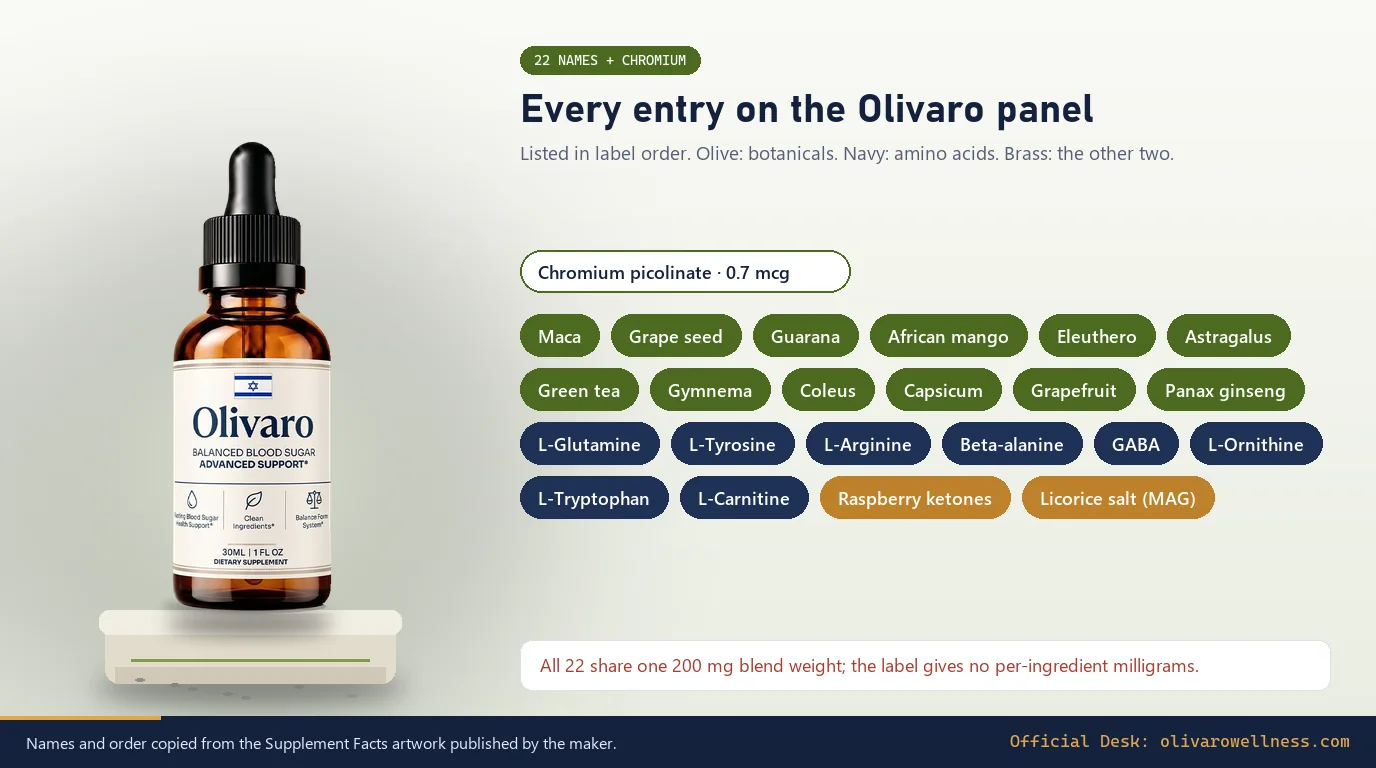
Reading the list: one number, one blend
The Olivaro panel is short to look at and long to read. It holds one line with a real amount, chromium picolinate at 0.7 mcg, and one line that says "Proprietary Blend 200 mg" followed by 22 names in a single paragraph. Everything the product does, if it does anything, has to come from those two lines.
A proprietary blend is legal. Federal labeling rules allow a company to print the combined weight of a blend instead of each ingredient's amount, on condition that the names appear in descending order of weight. That rule is the most useful tool a reader has: it tells us maca is the heaviest entry, grape seed second, guarana third and L-carnitine the lightest. It does not tell us whether maca is 150 mg and the other 21 share 50 mg, or whether the split is roughly even at about 9 mg each.
So this page does three things with each ingredient. It says what the ingredient is, it summarizes what human research found and at what dose, and it sets the most generous possible share of the blend against that dose. Whenever we write "under 200 mg", read it as a ceiling that the real amount cannot reach, because 21 other names occupy the same 200 mg.
One milliliter, one dropper. The serving is 1 mL, which is about one full dropper. The label allows 1 or 2 droppers a day, so the maximum daily intake is 400 mg of blend and 1.4 mcg of chromium.
The complete Olivaro ingredient table
All 22 blend entries in label order, with the group each belongs to, the use most often studied and the one caution worth knowing. Chromium sits outside the blend and is covered in the next section.
| # | Entry (label wording) | Group | Usually studied for | Main caution |
|---|---|---|---|---|
| 1 | Maca (Lepidium meyenii) root extract | Botanical | Energy, mood, libido | Few metabolic trials |
| 2 | Grape (Vitis vinifera) seed extract | Botanical | Blood pressure, antioxidant | May add to blood thinners |
| 3 | Guarana (Paullinia cupana) seed extract | Botanical | Alertness (caffeine) | Caffeine, unmeasured |
| 4 | African mango (Irvingia gabonensis) seed extract | Botanical | Weight, lipids | Trials small and flawed |
| 5 | Eleutherococcus senticosus root extract | Botanical | Fatigue, stress | May affect digoxin tests |
| 6 | Astragalus root extract | Botanical | Immune support | Immunosuppressant caution |
| 7 | Green tea (Camellia sinensis) leaf extract | Botanical | Glucose, weight | Rare liver injury; caffeine |
| 8 | Gymnema leaf extract | Botanical | Sweet taste, glucose | Adds to glucose-lowering drugs |
| 9 | Coleus forskohlii root extract | Botanical | Weight, body composition | Blood pressure drugs |
| 10 | Capsicum annuum fruit extract | Botanical | Thermogenesis | Stomach irritation |
| 11 | Grapefruit (Citrus paradisi) fruit extract | Botanical | Antioxidant | CYP3A4 drug interactions |
| 12 | Panax ginseng aerial extract | Botanical | Glucose, energy | Warfarin, MAOIs, glucose drugs |
| 13 | Raspberry ketones | Aroma compound | Weight (animal data) | No human trials |
| 14 | L-Glutamine | Amino acid | Gut, post-meal glucose | Studied in grams |
| 15 | L-Tyrosine | Amino acid | Alertness under stress | MAOIs, thyroid medicine |
| 16 | L-Arginine base | Amino acid | Blood flow | Blood pressure drugs, nitrates |
| 17 | Beta-alanine | Amino acid | Exercise capacity | Harmless tingling |
| 18 | Monoammonium glycyrrhizinate | Licorice salt | Sweetness, soothing | Blood pressure, potassium |
| 19 | GABA | Amino acid | Relaxation | Sedatives |
| 20 | L-Ornithine HCl | Amino acid | Fatigue, ammonia | Little data at this scale |
| 21 | L-Tryptophan | Amino acid | Sleep, mood | SSRIs, MAOIs, triptans |
| 22 | L-Carnitine base | Amino acid | Fat metabolism | Thyroid hormone, warfarin |
Two patterns stand out. First, the heaviest entries (maca, grape seed, guarana, African mango) are not the ones with the best glucose data. Gymnema, the plant most closely tied to sugar metabolism, sits eighth. Second, more than a third of the list is amino acids, which are normally taken in gram amounts and are unlikely to do much at a few milligrams each.
Chromium picolinate: the only disclosed dose
Chromium is a trace mineral found in broccoli, whole grains, meat and brewer's yeast. It is thought to help insulin signal inside cells, though its exact role is still debated and the Daily Value is just 35 mcg [1]. The panel's 0.7 mcg works out to 2% of that.
The trial most often quoted for chromium gave adults with type 2 diabetes 200 or 1,000 mcg a day for four months and found clearer improvements at the higher dose [2]. Pooled analyses since then found small average reductions in fasting glucose, with wide variation between studies [3], and an NIH-led review concluded that the evidence for routine use is limited [4].
At 0.7 mcg, Olivaro's chromium is a fraction of a percent of the doses that showed anything. It is also lower than what an ordinary day of food provides. We list it first because it is the one honest number on the panel, not because it is likely to matter.
The twelve botanicals, one by one
Maca root (first by weight)
A Peruvian root vegetable eaten as food for centuries. Reviews describe modest effects on mood and sexual desire, with almost no data on blood sugar [17]. Its place at the top of the list is the clearest sign that the blend leans toward energy rather than glucose.
Grape seed extract
Rich in proanthocyanidins. A meta-analysis found small falls in blood pressure and heart rate, not consistent glucose effects [19]. It may add to the action of blood thinners.
Guarana seed extract
One of the richest caffeine sources in nature. The label does not state a caffeine figure. The FDA treats 400 mg a day as a comfortable ceiling for healthy adults [10]; Olivaro's share is very likely a small fraction of that, yet sensitive people may notice it.
African mango seed extract
The extract IGOB131 at 150 mg twice daily cut weight and fasting glucose in a Cameroonian trial [11]. A systematic review judged the available trials too small and too poorly reported to rely on [12].
Eleuthero root extract
Sold as Siberian ginseng, though it is a different plant. Used for fatigue. It can interfere with some digoxin blood tests, which matters to anyone on that heart drug.
Astragalus root extract
A traditional Chinese herb promoted for immunity. NCCIH notes that rigorous human evidence is scarce and that it might interact with immune-suppressing drugs [18].
Green tea leaf extract
Catechins such as EGCG produced a small drop in fasting glucose across 17 trials [8]. Concentrated extracts are linked to rare liver injury, mostly at high doses or on an empty stomach [9].
Gymnema leaf extract
Leaf acids block sweet-taste receptors for a while after contact. Studies used about 400 mg daily of a standardized extract [5], and a 2021 meta-analysis reported lower fasting glucose and A1C [6]. The sales page claim of regenerating pancreatic cells rests mainly on animal work [7].
Coleus forskohlii root extract
The source of forskolin. A small trial in men reported changes in body composition but not in weight [13]. Forskolin can lower blood pressure.
Capsicum fruit extract
Chili pepper. Capsaicin raises energy use slightly; a review measured the effect at roughly 50 calories a day at doses well above this blend [14].
Grapefruit fruit extract
Grapefruit compounds can block CYP3A4, an enzyme that clears many medicines, raising their blood levels [20]. The amount here is unknown, so anyone on statins, felodipine, tacrolimus or similar drugs should check with a pharmacist.
Panax ginseng aerial extract
Leaves and stems, not root. Root extracts modestly lowered fasting glucose in pooled trials [15]. Ginseng can weaken warfarin's effect [16]; the vendor's description of it as "an ancient root" does not match the label.
Eight amino acids at milligram scale
Amino acids are building blocks of protein, and most are eaten in grams every day. A chicken breast holds several grams of glutamine alone. Inside a 200 mg blend shared with 14 other names, each of Olivaro's eight is a small fraction of what studies used.
| Amino acid | Typical study amount | Olivaro ceiling |
|---|---|---|
| L-Glutamine | 15 g before a meal [21] | under 200 mg |
| L-Tyrosine | 2 to 10 g in stress studies | under 200 mg |
| L-Arginine | 3 to 9 g a day | under 200 mg |
| Beta-alanine | 3.2 to 6.4 g a day [22] | under 200 mg |
| GABA | 100 to 300 mg | under 200 mg |
| L-Ornithine | 400 mg to 2 g | under 200 mg |
| L-Tryptophan | 1 to 2 g | under 200 mg |
| L-Carnitine | 1 to 3 g | under 200 mg |
The glutamine result deserves a note because it is the closest thing in the formula to a GLP-1 story: at 15 grams it raised GLP-1 and lowered post-meal glucose in people with type 2 diabetes [21]. That is around 75 times the whole blend. L-tryptophan matters for safety rather than effect, since it adds to serotonin and is a caution with SSRIs and MAOIs.
Raspberry ketones and the licorice salt
Raspberry ketones give raspberries their smell. They became a weight-loss fad after television coverage, based on rodent and cell studies. No controlled human trial supports them on their own.
Monoammonium glycyrrhizinate is a salt of glycyrrhizin, the sweet compound in licorice root. It is used as a flavor and soothing agent. Taken regularly in large amounts, glycyrrhizin raises blood pressure and lowers potassium [23][24]. The amount here is small and undisclosed; people with hypertension, heart failure, kidney disease or low potassium should still raise it with their clinician.
The base: glycerin, stevia, xylitol and preservatives
The "other ingredients" line reads: Glycerin, Water, Organic Lemon Extract, Stevia Extract 97% (Reb A), Xylitol, Sodium Benzoate, Potassium Sorbate, Citric Acid, and Natural Flavors. Glycerin and water carry the extracts. Organic lemon extract, natural flavors and citric acid shape the taste. Stevia (97% rebaudioside A) and xylitol sweeten without sugar. Sodium benzoate and potassium sorbate keep the opened bottle from spoiling.
Xylitol is the entry pet owners need to remember. In dogs it causes a rapid insulin release that can drop blood sugar dangerously and, in some cases, damage the liver [25]. Keep the bottle somewhere a dog cannot reach and wipe up any spill. In people, xylitol in these amounts is harmless, though large doses can loosen stools.
What is not in the bottle
Readers sometimes assume a glucose formula contains the ingredients they have read about elsewhere. Olivaro does not list any of the following, several of which have more human data than the entries it does use:
- Berberine, studied at 500 mg two or three times a day.
- Cinnamon (Cinnamomum cassia), studied at 1 to 6 g.
- Magnesium, often low in people with insulin resistance.
- Soluble fiber such as psyllium, which slows carbohydrate absorption.
- Alpha-lipoic acid, mainly studied for nerve symptoms.
- Bitter melon and fenugreek, common in other glucose blends.
None of this means you should add them. It means Olivaro is best understood as an energy-leaning botanical blend with a glucose label, and that a comparison shopper should read panels rather than headlines.
Questions readers send about this
How many ingredients are in Olivaro?
Twenty-three entries: chromium picolinate at 0.7 mcg, listed on its own, and 22 names inside a 200 mg proprietary blend. The sales page talks about six nutrients, which are simply the six it chose to describe.
Which Olivaro ingredient is the strongest?
By weight, maca root, because labeling rules list blend entries from heaviest to lightest. By glucose evidence, gymnema and chromium, yet chromium is only 0.7 mcg and gymnema is eighth in line, so neither is likely near a studied dose.
Does Olivaro contain caffeine?
Yes. Guarana seed and green tea leaf both contain caffeine. The label gives no figure; with both inside a 200 mg blend the amount is small, but caffeine-sensitive people may still notice it, especially at two droppers.
Is there sugar in Olivaro?
No sugar is listed. The drops are sweetened with stevia extract and xylitol, flavored with organic lemon extract and natural flavors, and preserved with sodium benzoate and potassium sorbate.
Is Olivaro safe for dogs?
No. The base contains xylitol, which is toxic to dogs even in small amounts. If a dog swallows any of the liquid, call a veterinarian or an animal poison line straight away.
Records cited on this page
Links go to the original abstract or agency page. Every trial below gave one ingredient on its own, mostly at doses far above what a 200 mg blend shared by 22 names could hold; nobody has published a trial of Olivaro itself.
- 1NIH Office of Dietary Supplements. Chromium: Fact Sheet for Health Professionals. ods.od.nih.gov/factsheets/Chromium-HealthProfessional/
- 2Anderson RA, Cheng N, Bryden NA, et al. Elevated intakes of supplemental chromium improve glucose and insulin variables in individuals with type 2 diabetes. Diabetes. 1997;46(11):1786-1791. pubmed.ncbi.nlm.nih.gov/9356027/
- 3Suksomboon N, Poolsup N, Yuwanakorn A. Systematic review and meta-analysis of the efficacy and safety of chromium supplementation in diabetes. J Clin Pharm Ther. 2014;39(3):292-306. pubmed.ncbi.nlm.nih.gov/24635480/
- 4Costello RB, Dwyer JT, Bailey RL. Chromium supplements for glycemic control in type 2 diabetes: limited evidence of effectiveness. Nutr Rev. 2016;74(7):455-468. pubmed.ncbi.nlm.nih.gov/27261273/
- 5Baskaran K, Kizar Ahamath B, Radha Shanmugasundaram K, Shanmugasundaram ER. Antidiabetic effect of a leaf extract from Gymnema sylvestre in non-insulin-dependent diabetes mellitus patients. J Ethnopharmacol. 1990;30(3):295-300. pubmed.ncbi.nlm.nih.gov/2259217/
- 6Devangan S, Varghese B, Johny E, et al. The effect of Gymnema sylvestre supplementation on glycemic control in type 2 diabetes patients: a systematic review and meta-analysis. Phytother Res. 2021;35(12):6802-6812. pubmed.ncbi.nlm.nih.gov/34467577/
- 7Kanetkar P, Singhal R, Kamat M. Gymnema sylvestre: a memoir. J Clin Biochem Nutr. 2007;41(2):77-81. pubmed.ncbi.nlm.nih.gov/18193099/
- 8Liu K, Zhou R, Wang B, et al. Effect of green tea on glucose control and insulin sensitivity: a meta-analysis of 17 randomized controlled trials. Am J Clin Nutr. 2013;98(2):340-348. pubmed.ncbi.nlm.nih.gov/23803878/
- 9LiverTox: Clinical and Research Information on Drug-Induced Liver Injury. Green Tea. National Institute of Diabetes and Digestive and Kidney Diseases. www.ncbi.nlm.nih.gov/books/NBK547925/
- 10U.S. Food and Drug Administration. Spilling the Beans: How Much Caffeine Is Too Much? www.fda.gov/consumers/consumer-updates/spilling-beans-how-much-caffeine-too-much
- 11Ngondi JL, Etoundi BC, Nyangono CB, Mbofung CM, Oben JE. IGOB131, a novel seed extract of the West African plant Irvingia gabonensis, significantly reduces body weight and improves metabolic parameters in overweight humans in a randomized double-blind placebo controlled investigation. Lipids Health Dis. 2009;8:7. pubmed.ncbi.nlm.nih.gov/19254366/
- 12Onakpoya I, Davies L, Posadzki P, Ernst E. The efficacy of Irvingia gabonensis supplementation in the management of overweight and obesity: a systematic review of randomized controlled trials. J Diet Suppl. 2013;10(1):29-38. pubmed.ncbi.nlm.nih.gov/23419021/
- 13Godard MP, Johnson BA, Richmond SR. Body composition and hormonal adaptations associated with forskolin consumption in overweight and obese men. Obes Res. 2005;13(8):1335-1343. pubmed.ncbi.nlm.nih.gov/16129715/
- 14Ludy MJ, Moore GE, Mattes RD. The effects of capsaicin and capsiate on energy balance: critical review and meta-analyses of studies in humans. Chem Senses. 2012;37(2):103-121. pubmed.ncbi.nlm.nih.gov/22038945/
- 15Shishtar E, Sievenpiper JL, Djedovic V, et al. The effect of ginseng (the genus Panax) on glycemic control: a systematic review and meta-analysis of randomized controlled clinical trials. PLoS One. 2014;9(9):e107391. pubmed.ncbi.nlm.nih.gov/25265315/
- 16Yuan CS, Wei G, Dey L, et al. Brief communication: American ginseng reduces warfarin's effect in healthy patients: a randomized, controlled trial. Ann Intern Med. 2004;141(1):23-27. pubmed.ncbi.nlm.nih.gov/15238367/
- 17Gonzales GF. Ethnobiology and ethnopharmacology of Lepidium meyenii (Maca), a plant from the Peruvian highlands. Evid Based Complement Alternat Med. 2012;2012:193496. pubmed.ncbi.nlm.nih.gov/21977053/
- 18National Center for Complementary and Integrative Health. Astragalus. www.nccih.nih.gov/health/astragalus
- 19Feringa HH, Laskey DA, Dickson JE, Coleman CI. The effect of grape seed extract on cardiovascular risk markers: a meta-analysis of randomized controlled trials. J Am Diet Assoc. 2011;111(8):1173-1181. pubmed.ncbi.nlm.nih.gov/21802563/
- 20Bailey DG, Dresser G, Arnold JM. Grapefruit-medication interactions: forbidden fruit or avoidable consequences? CMAJ. 2013;185(4):309-316. pubmed.ncbi.nlm.nih.gov/23184849/
- 21Samocha-Bonet D, Wong O, Synnott EL, et al. Glutamine reduces postprandial glycemia and augments the glucagon-like peptide-1 response in type 2 diabetes patients. J Nutr. 2011;141(7):1233-1238. pubmed.ncbi.nlm.nih.gov/21593352/
- 22Trexler ET, Smith-Ryan AE, Stout JR, et al. International Society of Sports Nutrition position stand: beta-alanine. J Int Soc Sports Nutr. 2015;12:30. pubmed.ncbi.nlm.nih.gov/26175657/
- 23National Center for Complementary and Integrative Health. Licorice Root. www.nccih.nih.gov/health/licorice-root
- 24Penninkilampi R, Eslick EM, Eslick GD. The association between consistent licorice ingestion, hypertension and hypokalaemia: a systematic review and meta-analysis. J Hum Hypertens. 2017;31(11):699-707. pubmed.ncbi.nlm.nih.gov/28660884/
- 25Dunayer EK, Gwaltney-Brant SM. Acute hepatic failure and coagulopathy associated with xylitol ingestion in eight dogs. J Am Vet Med Assoc. 2006;229(7):1113-1117. pubmed.ncbi.nlm.nih.gov/17014359/
Give Olivaro a measured 60-day trial
Checkout happens on the vendor's BuyGoods page. Note a week of morning readings before the first dropper; if the numbers have not moved by day 50, write to the vendor while the refund window is still open, opened bottles included.